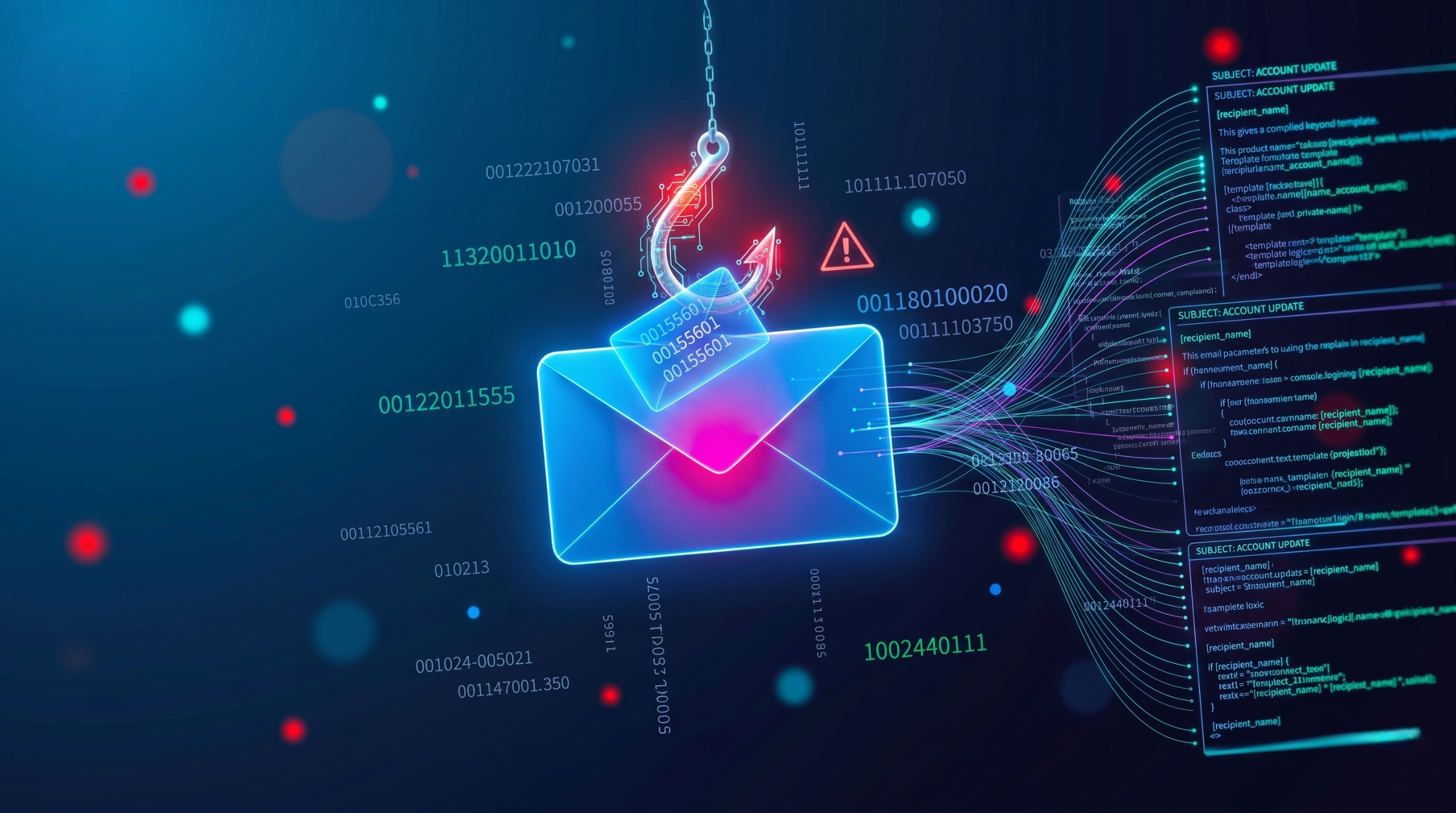
Open the template library of any major phishing simulation platform and the same scenarios appear. The fake DocuSign request. The Microsoft password reset. The DHL package notification. The Office 365 quota warning. These templates were created somewhere between 2017 and 2020, and they have been re-used, re-skinned, and re-distributed across millions of simulated phishing campaigns in the years since. The employees of one organization see broadly the same content as the employees of every other organization running on the same platform.
The problem is not that these templates were ever poorly written. The problem is that the phishing attacks they were modelled on have evolved past them. The grammatical errors that earlier templates relied on as detection cues have been engineered out of current attacks by attackers using the same generative AI tooling that knowledge workers now use for everyday writing. The generic greetings have been replaced by personalised salutations drawn from public LinkedIn profiles. The visual mismatches between brand and forgery have been eliminated by image generation. The result is that an awareness program running 2018-vintage templates against 2026-vintage attackers is producing optimistic click-rate numbers while leaving employees genuinely under-prepared for the messages that hit them outside the simulator.
This article covers what AI has actually changed about phishing email quality, why static template libraries cannot keep up, what AI-generated phishing simulation tools look like in practice, and how to evaluate them honestly when you assess awareness training platforms.
What AI Has Actually Changed About Phishing Email Quality
The shift is observable enough that security teams running phishing simulation programs for more than three years can describe it without statistics. The phishing emails reaching corporate inboxes today are different in five specific ways from the phishing emails reaching the same inboxes in 2020 and 2021.
Linguistic quality is no longer a detection cue. Generative AI tools, used routinely by knowledge workers for legitimate writing tasks, are also used routinely by attackers. The grammatical errors, awkward phrasing, and broken English that earlier training programs taught employees to look for now appear in well under half of real phishing emails. Microsoft's Digital Defense Report and Verizon's annual Data Breach Investigations Report have both documented the shift in language model availability and the corresponding improvement in attacker text quality.
Contextual personalisation operates at scale. Earlier targeted phishing required attacker time per recipient. Current tooling combines scraped LinkedIn data, organizational charts, recent news, and public commentary into personalised messages produced in seconds at thousands-per-hour throughput. The result is that the contextual personalisation that used to be the signature of expensive spear phishing is now applied to commodity phishing volumes.
Multilingual operation removes geographic moat. Phishing attacks that previously required local language fluency to be convincing can now be produced in dozens of languages with equal competence. Organizations operating in non-English markets are receiving phishing at the same quality level as their English-language counterparts, with regional context references that earlier multilingual attacks did not include.
Channel diversification accelerates. AI-generated content is not confined to email. The same tooling produces convincing WhatsApp messages, SMS texts, LinkedIn DMs, Teams messages, and Slack DMs. Awareness programs that train against email alone are leaving the rest of the attack surface uncovered.
Multi-stage attack composition is automated. Sequenced attacks that previously required attacker coordination — email to establish pretext, WhatsApp to follow up, voice call to close — can now be composed by tooling that maintains pretext consistency across channels.
The defensive implication is consistent. Awareness training that uses templates frozen at 2018 quality is preparing employees to spot a category of attack that has largely been replaced by a different category. The employees who pass these simulations are not necessarily prepared for the attacks they will actually encounter.
The Static Template Library Problem
The economics of static template libraries explain the lag. A vendor that has shipped the same hundred-plus templates to thousands of customers over multiple years has a substantial sunk cost in that library: localisations, translations, A/B-tested variants, brand-impersonation legal review, content review pipelines. Refreshing the library to reflect 2024-2026 attack quality is expensive, and the incentive to do it gradually rather than comprehensively is strong.
The customer-facing result is library updates that arrive in small batches, with the bulk of the catalogue continuing to reflect the pre-AI attacker era. A customer running their first simulation campaign sees the new templates. A customer running their fifth annual campaign sees most of the same templates they saw three years ago — because that is what the library still contains.
There is a second-order problem in this. Employees who have been trained on a specific template library begin to recognize the patterns of that library specifically rather than the underlying skill of phishing recognition. The click rate decreases over time, but the decrease may not generalise to real phishing attacks that look nothing like the simulation library. The result is the optimistic-data, under-prepared-employees paradox: the numbers improve while the actual phishing-driven incident rate does not.
This is one reason the difference between phishing simulation and security awareness training matters operationally: the simulation library trains employees to recognize the library, while the underlying awareness training is what builds recognition that transfers to real attacks. The fix is not better static templates. The fix is generation that produces fresh, context-appropriate, current-quality content on demand.
What AI-Generated Phishing Simulation Tools Actually Do
The category of AI-generated phishing simulation tools — sometimes marketed as "ai-driven phishing simulation platforms" or "ai-powered phishing simulations" — has matured significantly in the past two years. The pattern that produces real value, distinct from marketing claims, is consistent across the platforms that work well.
Context-driven generation. An owner or manager provides organizational context: the target audience, the role-specific pretext, the difficulty level, the industry, any organization-specific details that should appear. The AI generates a complete phishing email template — subject line, sender pretext, body copy — matched to that context. The output is not a recycled template with a name substituted in. It is a new template generated for the specific brief.
Schema validation and quality gates. Generation tools that work in production include quality gates: schema validation to ensure the output is well-formed, content filters to ensure no forbidden elements appear, retry logic with corrective feedback when the first generation does not meet the spec. The user does not see most of this; they see a clean template that arrives in seconds and is usable as-is or with minor edits.
Provider choice. Mature platforms allow customers to bring their own AI provider rather than locking them into the vendor's choice. OpenAI, Anthropic, and Google Gemini each have different strengths for different generation tasks; allowing customers to choose lets them route generation through the provider their security and procurement teams have already vetted.
Review and editing surface. The output is not the final word. Owners and managers review and edit before saving to their template library. The AI handles the heavy lifting of plausible drafting; the human applies organizational judgement and editorial polish.
Library integration. Generated templates become part of the tenant's template library, available for repeated campaigns and refinement over time. The library grows organically with the organization's actual usage rather than being capped at whatever the vendor preloaded.
PhishSkill's AI-powered phishing awareness training implements this pattern, and the structure described above is what we believe the category should look like — not because of marketing, but because the operational mechanics produce the behavioral outcomes that matter. The product page covers the specifics; this section is the category framing.
Bring Your Own AI Key vs. Vendor-Managed Generation
The two delivery models for AI generation in awareness platforms produce noticeably different procurement experiences.
Vendor-managed generation. The platform vendor provides the AI API keys, manages the cost, and exposes generation as a feature in the higher-tier plans. The customer does not see the underlying provider, does not manage cost limits, and pays the vendor a uniform price that includes generation overhead. The benefit is operational simplicity: AI generation just works. The trade-off is that customers cannot route generation through providers they have specifically vetted, and the per-token economics are bundled into the platform's pricing rather than visible.
Bring Your Own AI Key (BYOAK). The customer provides their own OpenAI, Anthropic, or Gemini API key. Generation routes through that key, billed to the customer's provider account, subject to the customer's own usage policies and security controls. The benefit is governance and cost transparency: the customer's existing AI procurement, data residency, and audit posture extends to phishing simulation. The trade-off is one additional configuration step at setup time.
For enterprise security teams that already have a vetted AI provider, BYOAK is usually the better fit because it does not introduce a new data-residency conversation. For smaller teams that want zero-config generation, vendor-managed is usually the better fit. Mature platforms offer both.
PhishSkill offers vendor-managed AI on the Premium plan and BYOAK on all plans including the 30-day Starter trial. The two models coexist, and the choice is the customer's.
How to Evaluate AI Generation in Awareness Platforms
A specific evaluation framework distinguishes genuinely useful AI generation from "generation" that is essentially template variable substitution rebranded.
Ask for unedited sample output. Request three generated templates from three different briefs you provide on the spot, with no vendor intervention between the prompt and the output. Read them. If the output sounds like a recycled template with names changed, the generation is shallow. If the output reads like a plausible draft that needs only light editorial work, the generation is doing real work.
Ask which providers are supported. If the answer is "our own," push for transparency on which model and which provider. If the answer covers OpenAI, Anthropic, and Gemini, ask whether BYOAK is available. Multi-provider support indicates a vendor that has not over-fitted to a single API and can adapt as the AI landscape evolves.
Ask about quality controls. Schema validation, content review gates, retry-with-corrective-feedback loops, role-fit checks. The presence of these mechanics indicates that the vendor has invested in production-grade generation rather than bolting an LLM call onto an existing template engine. The absence indicates the opposite.
Ask how often the output changes. If two calls with similar briefs return nearly identical text, the diversity layer is missing and the platform will reproduce the static-template problem with extra steps. If two similar calls return meaningfully different drafts, the platform is generating rather than retrieving.
Ask about review and edit surface. Generation that is not reviewable and editable is generation you cannot trust for production use. The owner needs to see the output, modify it where necessary, and save the approved version to the library.
Ask about the difficulty and channel scope. Email-channel generation is currently the most mature. Multi-channel generation (email plus WhatsApp, plus other surfaces) is emerging. Difficulty calibration — easy, medium, hard scenarios for different audience segments — distinguishes mature platforms from prototype ones.
For platforms that pass this evaluation, AI generation becomes the engine that keeps the awareness program honest. Templates stay current because they are generated current. Coverage extends with each campaign because new content is produced on demand. The optimistic-data paradox shrinks because the simulation surface reflects the attack surface.
The Cost of Staying Static
The case for moving past static template libraries is straightforward in outcome terms.
Skill specificity instead of generalised recognition. Employees who have trained against current-quality content recognize current-quality attacks. Employees who have trained against 2018-vintage content recognize 2018-vintage attacks, which they may rarely encounter.
Operational tempo matches the attacker tempo. Attackers iterate continuously. Static libraries do not. Generation closes the iteration gap by producing new content on the security team's timescale rather than the vendor's release cycle.
Program defensibility. Auditor and board conversations about awareness training maturity increasingly include questions about content currency. "We use the same templates we used three years ago" is no longer a defensible answer in regulated industries. "We generate scenarios for current threat patterns, reviewed by our security team, and run them through our simulation library" is.
Channel coverage that scales. AI generation makes channel diversification operationally feasible. Producing equivalent-quality phishing content across email and WhatsApp is a much smaller incremental burden when generation does the heavy lifting than when the security team has to write each variant from scratch.
The transition cost is real but small. An organization moving from a static library to AI-augmented generation typically goes through a brief period of getting the prompts right, refining the review workflow, and building organizational comfort with generated content. The first month involves more editorial intervention than the third month. By the sixth month, the security team is producing more varied, more relevant, more current content than the static library ever provided.
The opportunity cost of staying static is the harder number to compute. Organizations that continue training employees against five-year-old attack patterns produce employees who are five years behind the actual threat landscape. The incidents that result do not appear as line items in the awareness program budget; they appear in incident response, in credential exposure reports, and in the breach notification statistics that the next annual phishing benchmarks will summarise.
The Underlying Defense Has Not Changed
It is worth ending on what AI generation does not solve. The behavioral defences that protect against phishing remain what they have always been: verification habits for high-stakes requests, healthy skepticism toward urgency and authority, organizational norms that make out-of-band confirmation routine, a reporting culture that converts recognition into defensive action. AI generation refreshes the content that builds these behaviors. The behaviors themselves are the durable defense.
This is the case for AI-generated phishing simulation tools, properly understood. Not "the AI catches the attack" — the AI keeps the awareness training honest. The employees do the catching. The verification habits do the work. The platform is the training engine that keeps both calibrated to the actual threat.
Static template libraries did this job once. They no longer do. The organizations that recognize the shift and rebuild their awareness training around current-quality, AI-generated content are the ones whose employees will recognize the next attack. The organizations that do not will continue to celebrate falling simulation click rates while their actual breach exposure grows.
Related Reading
For the foundation, What Is Phishing Awareness Training? covers the broader program framework, and What Is a Phishing Simulation? explains the underlying measurement layer.
For the attack-side context, AI-Generated Phishing Emails: Why They Are Harder to Detect documents what attackers are sending. For the targeted-attack angle, Spear Phishing Simulation for Enterprise covers how AI-augmented content reshapes high-value-target campaigns.
For program design, How to Build a Security Awareness Program from Scratch and How Often Should You Run Phishing Simulations cover the implementation details.
External authority: the Verizon Data Breach Investigations Report provides the longitudinal data on phishing-driven incidents, and Microsoft's Digital Defense Report documents the AI-augmented threat landscape from the platform side.
Ready to move past static templates? Start a free 30-day Starter trial, or learn how PhishSkill's AI-powered phishing awareness training handles the generation workflow end-to-end.
More from the Blog
View all blog articles
NFC and Contactless Payment Fraud: What UAE Employees and Organizations Need to Know
The UAE's high contactless adoption creates exposure to NFC skimming, relay attacks, and mobile wallet fraud. Train employees to protect corporate cards and expense accounts.

Zero Trust Security Doesn't Work Without Employee Awareness: The Human Layer That Architecture Ignores
Zero trust eliminates the network perimeter but still fails when employees hand over credentials to phishers. Learn how awareness training implements zero trust principles at the human layer.

Spear Phishing Simulation for Enterprise: How to Test and Defend Against Targeted Attacks
Generic phishing simulations test whether employees can recognize mass-market attacks. Spear phishing simulations test whether they can recognize attacks designed specifically to fool them. These are different problems.
Ready to stop phishing attacks?
Run realistic phishing simulations and high-impact security awareness training with PhishSkill's automated platform.