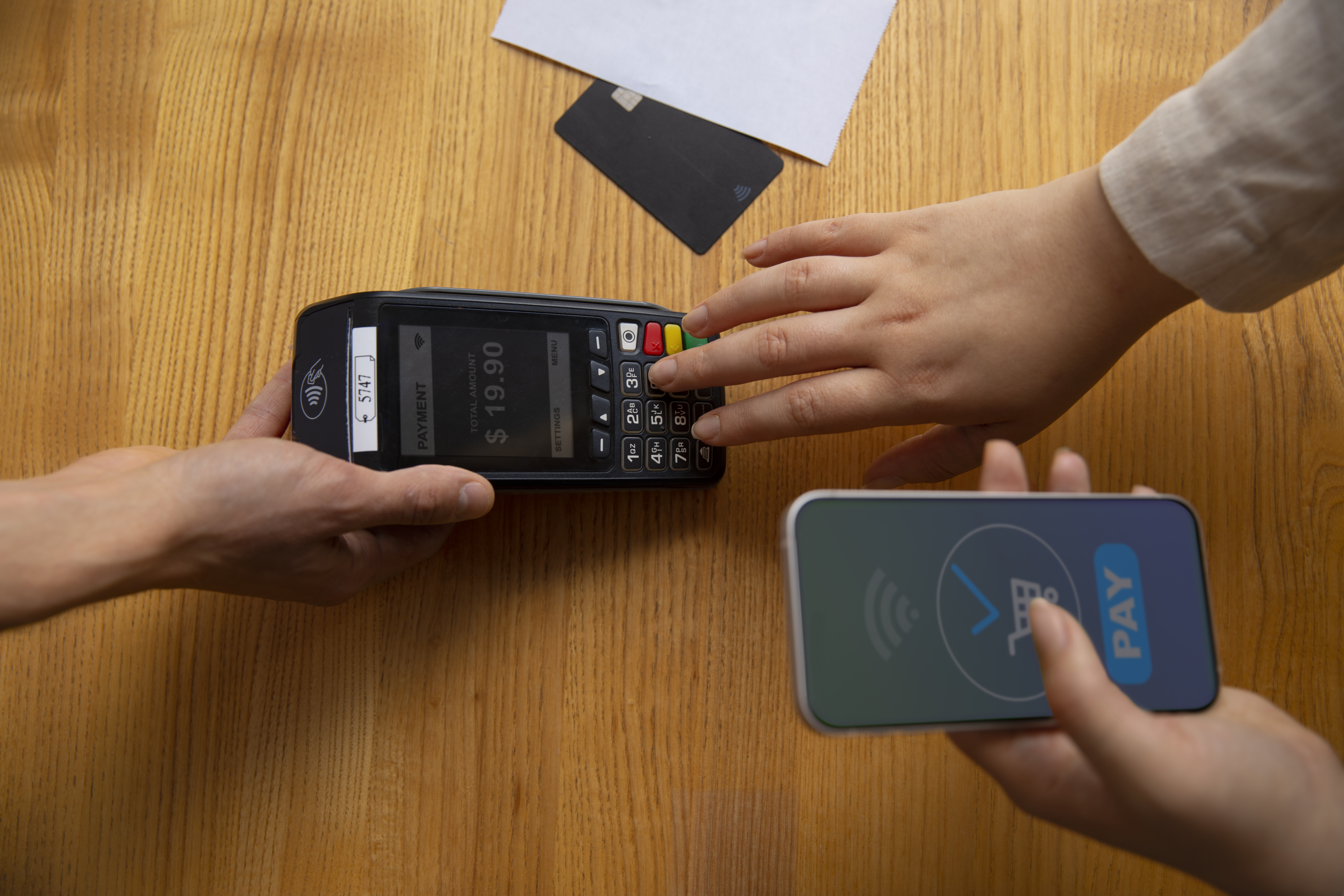
The UAE is one of the world's leading contactless payment markets. Network International data consistently shows UAE contactless payment rates among the highest globally, driven by near-universal merchant terminal acceptance, Apple Pay and Google Pay adoption, and the cultural preference for fast, frictionless transactions. In malls, petrol stations, supermarkets, restaurants, and taxis, the tap-to-pay habit is deeply embedded across all demographic groups.
For organizations that issue corporate payment cards and manage company expense accounts, this contactless payment ecosystem creates specific security risks that are distinct from traditional payment card fraud — and that most security awareness programs do not address adequately. It is a natural extension of the consumer-facing threats covered in our guide to retail banking fraud awareness for UAE bank customers, viewed from the organization's side of the card.
How NFC and Contactless Payment Attacks Work
NFC skimming. Near-field communication (NFC) technology, which enables contactless payments, transmits card data over very short distances — typically 4 centimeters or less. However, research has demonstrated that sophisticated readers can capture this data from greater distances than the specification intends, particularly with cards that do not use dynamic cryptography for every transaction. An attacker with a concealed NFC reader device in a crowded location — a mall, a metro car, an elevator — can potentially capture card data from cards in pockets and bags.
Relay attacks. Relay attacks extend the effective range of NFC transactions by using two devices — one near the victim's card and one near a payment terminal. The devices relay signals between the card and the terminal in real time, enabling a transaction to be authorized even when the card is far from the terminal. This attack requires technical sophistication but has been demonstrated in controlled settings.
Stolen card contactless fraud. The most common contactless payment fraud in the UAE is simpler: a stolen physical card is used for tap-to-pay transactions below the PIN verification threshold. The UAE's contactless payment limit — transactions below AED 500 (raised to AED 500 from the previous AED 300 threshold in recent years) do not require PIN entry — creates a window for rapid, repeated fraudulent transactions before the card is cancelled. This PIN-free threshold is set by the Central Bank of the UAE as part of its retail payments oversight.
Mobile wallet fraud. Apple Pay, Google Pay, and Samsung Pay bound payment card credentials to a specific device through tokenization. However, if an attacker gains access to the victim's iPhone or Android device — through theft, or through the kind of social engineering that phishing simulation in financial services is designed to inoculate staff against — they can access mobile wallets and make contactless payments with the enrolled cards.
Compromised corporate card data in payment data breaches. Corporate payment cards are enrolled in online services, travel booking platforms, and vendor portals. When those services suffer data breaches, corporate card details are exposed. While the card itself remains physically secure, the digital card data can be used for card-not-present fraud — but also sometimes for creating digital wallet additions if the attacker can intercept SMS verification codes. Breached card data frequently circulates alongside leaked credentials, a risk explored in our guide to dark web credential exposure.
Social engineering targeting expense report processes. The contactless payment fraud most commonly affecting UAE organizations is not technical — it is social. Employees submitting fraudulent expense claims, vendors billing for services not rendered, and internal fraud using corporate card access represent the dominant sources of corporate payment loss. Security awareness programs should address both technical contactless fraud and the human-factor dimension of expense management — the same internal-risk territory examined in our analysis of insider threats in UAE financial services.
Corporate Exposure: Why This Matters Beyond Personal Cards
Individual consumer contactless payment fraud is primarily a personal inconvenience — the bank's fraud protection typically covers unauthorized transactions on personal cards. Corporate payment card exposure is a more complex issue for organizations.
Corporate card liability. The liability terms for corporate payment cards differ by issuing bank and card agreement. Some corporate card programs place more liability on the organization than consumer card programs. Employees need to understand that corporate card fraud is not automatically the bank's problem.
Expense account fraud enabling. Corporate cards with high spending limits and weak expense monitoring controls are attractive targets for internal fraud. Contactless payment's invisibility in the transaction record — a tap that takes under a second and leaves no paper trail — makes it easier to rationalize or conceal unauthorized personal expenditure.
Vendor card data exposure. Organizations with large vendor bases often provide card details to suppliers for recurring billing. Each supplier represents an additional party that holds the organization's payment card data — and a potential breach source. Organizations bound by card-handling obligations should align this with their PCI DSS security awareness training, and treat every vendor relationship as a possible vector for the business email compromise attacks now common across the GCC.
Travel and entertainment card misuse. UAE organizations with frequent-traveling employees who use corporate cards for business travel face specific risks: card skimming in international locations with lower payment security standards, fraudulent charges on international hotel bills, and rental car deposit holds that are not released.
What UAE Employees Need to Know
Use RFID-blocking wallets or sleeves for corporate cards. RFID-blocking wallets and card sleeves prevent NFC skimming in crowded public places. While the practical risk of sophisticated NFC skimming attacks is lower than many dramatic presentations suggest, the cost of prevention — an RFID-blocking sleeve — is negligible. Organizations can provide these to employees who use corporate cards.
Check corporate card statements regularly. The most effective defense against contactless card fraud is rapid detection. Employees using corporate cards should review their statements — ideally weekly — and report any unrecognized transactions immediately. Many corporate card programs now offer real-time transaction notifications; employees should enable these.
Report lost or stolen corporate cards immediately. Unlike personal cards where loss may be discovered through a declined transaction, corporate card loss should be reported the moment it is discovered — regardless of the time of day. Every hour of delay increases the potential for unauthorized contactless transactions below the PIN threshold.
Protect mobile devices enrolled in mobile payment. A device enrolled with Apple Pay or Google Pay and containing corporate card credentials should be protected with strong biometric authentication and a secure device PIN. Employees should understand that a lost phone with corporate cards in Apple Pay is a payment security incident, not just a device loss.
Never share corporate card details through insecure channels. Corporate card numbers should never be shared through WhatsApp, email, or any unencrypted channel. When card details must be provided to a vendor, this should be done through a secure payment portal, over the phone directly to a verified vendor representative, or through the organization's procurement system — practices that mirror the cardholder-data handling rules published by the PCI Security Standards Council. For customer-facing teams that process payments directly, the frontline guidance in our guide to cybersecurity awareness for UAE retail and e-commerce reinforces these habits at the point of sale.
Organizational Controls Supporting Awareness
Security awareness around contactless payment fraud is most effective when supported by organizational controls:
Real-time transaction alerts. Configure corporate card programs to send real-time transaction notifications for all expenditure — providing immediate visibility of potentially fraudulent transactions.
Spending limits by category. Configure corporate cards with merchant category code (MCC) restrictions that match the employee's role — limiting a sales team member's card to travel, meals, and entertainment MCCs, rather than allowing unrestricted spending.
Expense management integration. Integrate corporate card transactions with expense management platforms (SAP Concur, Expensify, or similar) that require receipts and approval for all transactions, making unauthorized expenditure harder to conceal.
Regular card statement audits. Finance teams should conduct periodic reviews of corporate card statements against submitted expense reports, looking for patterns that suggest misuse.
Key Takeaways
The UAE's contactless payment infrastructure is a genuine productivity enabler, and the fraud risks associated with NFC technology — while real — are often overstated relative to the more mundane fraud risks of lost cards and expense account misuse. Security awareness training that addresses both the technical contactless payment risks and the human-factor dimensions of corporate card fraud will help UAE organizations protect their payment assets more effectively than technical controls alone. The key behaviors — regular statement review, immediate loss reporting, mobile device protection, and secure card detail handling — are straightforward to communicate and significantly reduce organizational exposure.
PhishSkill helps UAE organizations turn payment security guidance into reliable employee habits. Our awareness training and email and WhatsApp simulations teach staff to recognize the social engineering behind card and credential compromise, handle corporate card data securely, and report losses without delay — so a tap-to-pay culture does not become a tap-to-fraud liability. Let's discuss how to build payment fraud awareness your finance and travel teams will actually follow.
Related Reading
More from the Blog
View all blog articles
Phishing Simulation Results: Every Metric in Your Report Explained
A phishing simulation produces a dozen numbers, and most teams act on the wrong one. Here is what every field in your report means, and the action each one triggers.

Business Email Compromise in the GCC 2026: How the Attacks Have Evolved and How to Stay Ahead
BEC attacks targeting GCC organizations have evolved beyond simple email spoofing. AI-generated content, vendor account compromise, and multi-channel attacks define the 2026 threat landscape.

Business Email Compromise Prevention Training: Building Verification Habits That Stop Wire Fraud
Business email compromise is the single most financially damaging form of cybercrime. It is also one of the most preventable—when employees are trained to recognize and verify the specific patterns it exploits.
Ready to stop phishing attacks?
Run realistic phishing simulations and high-impact security awareness training with PhishSkill's automated platform.