When your organization runs a phishing simulation and analyzes the results, most of the attention goes to two numbers: the percentage who clicked and the percentage who reported. Those metrics matter, but they are incomplete. They tell you what happened, not when it happened.
The time between when a phishing email arrives in an employee's inbox and when that employee reports it to the security team is one of the most strategically significant metrics in security awareness measurement—and one of the most frequently ignored.
That time gap—measured in minutes or hours for high-performing organizations, measured in days for others—determines how many additional employees receive and potentially interact with the same phishing campaign before the security team can block it. It determines whether the security team can contain a credential compromise before the attacker uses the harvested credentials. It determines whether an organization responds to phishing incidents or merely documents them after the damage is done.
Industry benchmarks reveal dramatic variation in average time to report across sectors, and more importantly, they reveal that the variation is driven primarily by organizational design choices rather than employee capability differences. This guide provides detailed time-to-report data across industries and explains how to interpret and act on this metric in ways that produce measurable risk reduction.
Why Time to Report Matters More Than You Think
Before examining industry benchmarks, it is worth establishing why reporting speed deserves as much attention as reporting rate—because the strategic value of fast reporting is less intuitive than the value of high reporting.
Consider two scenarios. In the first, an organization achieves a 35 percent reporting rate on a phishing simulation, with reports arriving over a twelve-hour window. In the second, an organization achieves a 25 percent reporting rate, with 80 percent of those reports arriving within the first thirty minutes after the simulation is sent.
The first organization has more employees who report. The second organization has faster collective threat detection. In most operational threat scenarios, the second organization is safer.
When a phishing campaign hits an organization, the time window during which the attacker can exploit the campaign is constrained by how quickly the security team identifies and blocks it. A campaign that is identified and blocked within thirty minutes might compromise ten employees. The same campaign that is not identified for six hours might compromise two hundred.
Fast reporting creates the possibility of early containment. Employees who report phishing emails within minutes of receipt give the security team the opportunity to block the sender, warn the broader organization, and potentially prevent the majority of would-be victims from ever seeing the email. Employees who report the same emails hours or days later provide useful threat intelligence but enable little operational response.
Time to report is also a proxy for organizational security awareness culture. Employees who check email constantly and who integrate security reporting into their immediate workflow report threats faster than employees who batch-process email once or twice per day and who treat security reporting as a separate task to handle later. The speed of reporting reveals something about how central security is to employee consciousness, not just whether employees know they should report.
Healthcare: Hours to Report, Structural Time Constraints
Healthcare organizations show the longest average time to report phishing emails across industry benchmarks, with median times typically in the three- to five-hour range and significant right-tail distribution where some reports arrive days after the initial email.
The factors that drive healthcare's elevated phishing susceptibility and suppressed reporting rates also extend time to report. Clinical staff do not check email continuously during shifts—they check it during breaks, between patients, or at the end of shifts. A phishing email that arrives at 9 AM to a nurse working a twelve-hour shift may not be seen until 3 PM and may not be reported until 6 PM when the shift ends and the employee has time to navigate the reporting interface.
Healthcare reporting speed is also constrained by the technical infrastructure available to clinical staff. Nurses and physicians who access email primarily through shared workstations or through mobile devices often lack the streamlined reporting mechanisms that desk-based employees take for granted. Reporting a suspicious email from a mobile device frequently requires more steps—screenshotting, emailing to a security address, describing the threat—than reporting from a desktop with an integrated reporting button. That friction adds time.
Academic medical centers and large hospital systems that have invested in one-click mobile-accessible reporting mechanisms achieve meaningfully faster reporting times—median times in the two- to three-hour range—than organizations where reporting requires navigating to a separate portal or composing an email manually. The difference is not employee motivation; it is interface design.
The time-to-report challenge in healthcare creates genuine operational risk. Phishing campaigns targeting healthcare organizations—particularly those designed to harvest EHR credentials or to distribute ransomware—are most dangerous in the first few hours after launch when the security team has not yet identified the campaign and employees across the organization are independently encountering the same malicious emails. A four-hour average time to report means four hours during which the attack can spread unchecked.
Healthcare organizations that achieve faster reporting times typically do so through a combination of simplified reporting interfaces and cultural messaging that frames immediate reporting as patient safety, not administrative obligation. When reporting is positioned as "protecting our patients' data" rather than "completing a security task," clinical staff treat it with the urgency they apply to other patient safety concerns.
Financial Services: Moderate Speed, Process-Oriented Response
Financial services organizations typically show average time to report in the one- to three-hour range, reflecting the sector's process-oriented culture and the relatively high proportion of desk-based employees who maintain continuous email access.
Financial services employees check email frequently as a core work activity—client communications, transaction confirmations, market updates, internal coordination all flow through email continuously. This creates favorable conditions for fast detection: phishing emails are typically seen within minutes of arrival rather than hours.
However, the time from viewing a suspicious email to reporting it is longer in financial services than in some other sectors because employees often apply deliberate evaluation before reporting. The professional culture of financial services emphasizes careful verification and avoiding false alarms. Employees who encounter an ambiguous email may spend time attempting to independently verify whether it is legitimate—checking sender information, reviewing recent communications, consulting with colleagues—before deciding to report it.
That deliberate evaluation is professionally appropriate in many financial services contexts. An employee who receives an unexpected email claiming to be from a client should verify whether it is legitimate before acting on it. But the verification process extends time to report, creating a window during which other employees may encounter and potentially act on the same malicious email.
The financial services organizations that achieve fastest reporting times—median times under one hour—typically use security awareness training that explicitly teaches employees to report first and verify second when they encounter unexpected financial communications. The training creates a norm: if an email triggers any suspicion, report it immediately and let the security team verify legitimacy. That cultural framing reduces the time employees spend in individual evaluation and accelerates collective detection.
Financial services organizations also benefit from relatively mature security infrastructure that makes reporting technically fast. Most large financial institutions have integrated reporting buttons in email clients that allow one-click submission, and their security teams typically acknowledge reports within minutes, creating a feedback loop that reinforces fast reporting behavior.
Technology: Fastest Reporting, Continuous Email Access
Technology sector organizations show the fastest average time to report across industry benchmarks, with median times commonly in the thirty-minute to one-hour range and top-performing organizations achieving median times under thirty minutes.
Several factors converge to produce this speed advantage. Technology employees are predominantly desk-based knowledge workers with continuous computer access and high email engagement. They check email constantly throughout the workday, creating minimal delay between email arrival and detection.
Technology sector security culture also normalizes fast escalation of potential threats. In engineering organizations where identifying and reporting bugs, outages, and security issues quickly is valued professional behavior, reporting a suspicious email feels like the same category of action. The cultural expectation is that when you see something anomalous, you alert others immediately rather than investigating independently.
Technology organizations also tend to have the most streamlined technical reporting infrastructure. One-click reporting buttons integrated directly into email clients are standard, and security teams often respond to employee reports with automated acknowledgment within seconds. That immediate feedback reinforces the behavior of fast reporting.
However, technology sector reporting speed shows substantial internal variation. Technical employees—engineers, product managers, security staff—often report within minutes of encountering a suspicious email. Non-technical employees in the same organizations—sales, marketing, administrative staff—show reporting times more similar to other industries, often in the one- to two-hour range.
This internal variation creates a blind spot. Attackers who target technology organizations increasingly focus on non-technical employee segments precisely because those employees are both slower to detect threats and more likely to have access to valuable data—customer information, pricing, partnership details, strategic plans. An aggregate reporting time of forty-five minutes that conceals a two-hour reporting time for sales and marketing staff may significantly understate actual detection speed for the attacks that matter most.
Technology organizations that address this gap explicitly—by providing role-specific reporting training to non-technical staff and by measuring reporting time by department rather than only in aggregate—can reduce internal variation and achieve faster organization-wide detection.
Education: Slowest Detection, Asynchronous Email Patterns
Educational institutions show some of the slowest average time to report in industry data, with median times often exceeding six hours and substantial variation that creates long-tail distributions where some reports arrive days or even weeks after the initial email.
The structural factors that suppress reporting rates in education also extend time to report. Faculty members do not maintain continuous email access throughout the workday in the same way that desk-based corporate employees do. A professor teaching back-to-back classes may not check email from 9 AM to 3 PM. An adjunct instructor who teaches evening classes may check work email only a few times per week.
Administrative staff in educational institutions face similar time constraints as healthcare clinical staff—high workload, limited breaks, competing demands that take precedence over email monitoring. Facility staff, grounds workers, and other non-office personnel may check email infrequently because it is peripheral to their core responsibilities.
The combination of infrequent email checking and limited security awareness creates extremely slow collective detection. A phishing campaign that hits a university on Monday morning may not receive its first employee report until Monday afternoon, and many employees may not see the email until Tuesday or later. During that window, the campaign can spread unchecked across a large population.
Educational institutions that achieve faster reporting times—median times in the two- to four-hour range, comparable to healthcare—typically do so by targeting reporting training at the employee populations who do maintain continuous email access: full-time administrative staff, IT personnel, departmental coordinators, and student employees who work in offices. Those populations, though smaller than the total workforce, can provide early warning that allows the security team to block campaigns before they reach the broader employee population.
The other intervention that improves education sector reporting speed is mobile-accessible simplified reporting. Faculty and staff who can report suspicious emails with a single tap on a smartphone report hours faster than those who must access a desktop computer to navigate a reporting portal.
Government and Public Sector: Variable Speed by Agency Type
Government and public sector time to report varies dramatically by agency type and size. Federal agencies with mature security programs typically achieve median reporting times in the one- to three-hour range. State and local government organizations without dedicated security teams often show median times exceeding four hours.
The variation reflects both security culture maturity and operational context. Federal employees in office-based roles maintain email access patterns similar to private sector knowledge workers and operate under security awareness programs that emphasize fast threat reporting. Law enforcement, inspection, and field personnel in the same agencies may check email far less frequently and take longer to report when they do encounter threats.
State and local government organizations face the additional challenge of limited security team capacity. In organizations where the security team consists of one or two people managing IT security alongside other IT responsibilities, employee reports may sit unacknowledged for hours because there is no dedicated incident response capacity. That lack of responsiveness then reduces employee motivation to report quickly in the future—if reports are not acknowledged or acted on, there is no incentive to prioritize speed.
Government organizations that achieve fast reporting times typically do so through automated acknowledgment systems that respond to every report immediately, even if human triage takes longer. The automated response creates the perception of security team engagement that motivates continued fast reporting, even when actual security team response may be delayed.
The other pattern that drives government reporting speed is executive messaging. Agencies where leadership visibly treats security reporting as mission-critical—where secretaries, directors, and senior managers explicitly communicate that fast threat reporting protects agency operations—see measurably faster employee reporting than agencies where security is treated as an IT concern rather than an organizational priority.
Retail and Hospitality: Batch Processing Creates Delay
Retail and hospitality organizations typically show average time to report in the three- to six-hour range, reflecting work patterns where email is checked periodically rather than continuously and where email is not a primary communication channel for most employees.
Store managers, hotel front desk supervisors, and restaurant general managers typically check email once or twice per shift rather than continuously. Corporate employees in retail and hospitality organizations maintain more continuous email access and report faster, but the frontline operational employees who constitute the majority of the workforce operate on a batch-processing email pattern that creates inherent delay.
Seasonal variation in retail and hospitality creates predictable reporting speed patterns. During peak operational periods—holiday retail season, summer tourism season, major event weekends—when employee attention is maximally focused on operational demands, time to report extends significantly. A suspicious email encountered during a rush period may not be reported until hours later when the employee has time to shift attention to administrative tasks.
The organizations that achieve faster reporting in retail and hospitality tend to be those that have shifted security reporting from an email-based workflow to a mobile-app-based workflow. Employees who can report suspicious communications with a single tap on their personal smartphone during a thirty-second break report hours faster than employees who must wait until they have access to a computer.
Professional Services: Variable Speed by Seniority and Role
Professional services firms typically show average time to report in the two- to four-hour range, with substantial variation by employee seniority and role that creates opportunities for targeted improvement.
Associates and junior professionals in law firms, accounting firms, and consulting practices tend to maintain continuous email access and to report suspicious emails relatively quickly—often within one to two hours. Partners and senior professionals who operate with greater autonomy and who manage email less continuously show longer reporting times, often three to six hours.
This inverted speed pattern—where junior employees detect threats faster than senior employees—is the opposite of the pattern for training completion, and it creates different strategic implications. In most professional services attacks, the highest-value targets are senior professionals who have access to the most sensitive client information and the most valuable deal flow. Slower detection by that population creates the longest windows for attackers to exploit compromised credentials.
Professional services firms that address this challenge typically use peer influence and senior leadership modeling. When managing partners and practice group leaders visibly report suspicious emails quickly and when firms communicate stories of senior professionals who detected and escalated threats before damage occurred, the cultural norm shifts toward faster reporting at all seniority levels.
The other factor that drives professional services reporting speed is client service framing. When security teams position fast threat reporting as protecting client confidentiality and professional reputation—not as IT compliance—professional services employees treat it with the urgency they apply to other client service concerns.
The Reporting Speed Distribution: Why Medians Miss the Point
Industry benchmark data for time to report is typically presented as median or average values, but those summary statistics conceal strategically important variation in the distribution of reporting times.
Most organizations show a bimodal distribution of reporting times. A first wave of reports arrives quickly—within the first thirty to sixty minutes after a phishing simulation is sent. These are the employees who check email continuously, who have security awareness top of mind, and who use streamlined reporting mechanisms. A second wave of reports arrives hours later—three to eight hours after the simulation—from employees who check email less frequently or who batch-process reporting tasks.
The proportion of total reports that arrive in the first wave versus the second wave varies significantly across organizations and is more strategically meaningful than the overall median time to report. An organization where 60 percent of reports arrive within the first hour has fundamentally different early warning capability than an organization where only 20 percent of reports arrive in the first hour, even if both organizations have similar median reporting times.
High-performing organizations optimize for increasing the proportion of fast reports rather than reducing the median time to report. The interventions are different. Reducing median time to report requires changing behavior among the slowest reporters—employees who check email infrequently and who may lack the time or technical access to report quickly. Increasing the proportion of fast reports requires amplifying the behavior of employees who are already disposed to report quickly and removing the friction that prevents them from doing so.
The strategic focus on fast-reporter optimization recognizes that in most operational phishing scenarios, having ten employees report within thirty minutes provides more defensive value than having fifty employees report within six hours. The early reports enable containment. The late reports document damage already done.
For organizations looking to benchmark the difficulty of their simulations and the context of their results, the NIST Phish Scale provides a standardized framework for analyzing why employees click or report based on specific cues and relevancy.
Friction Points That Add Minutes (And Why They Matter)
Industry data on time to report reveals several specific friction points that add measurable time to the reporting process—and that are within organizational control to eliminate.
Multiple clicks to report. Organizations where reporting requires opening a menu, navigating to a reporting function, and confirming submission show reporting times an average of eight to twelve minutes longer than organizations where reporting requires a single click. That difference compounds across an employee population. In a thousand-person organization receiving a phishing campaign, twelve-minute-per-report delay translates to collective detection delay measured in hours.
Lack of mobile accessibility. Employees who encounter suspicious emails on mobile devices but must wait to access a desktop computer to report them show reporting times twenty to forty minutes longer than employees who can report directly from mobile. Organizations that design reporting mechanisms for desktop-only access sacrifice fast detection from the growing proportion of employees who interact with email primarily through mobile devices.
Acknowledgment delay. Employees who report suspicious emails and receive immediate automated acknowledgment report subsequent threats an average of fifteen to twenty minutes faster than employees whose reports receive no acknowledgment. The psychological reinforcement of immediate acknowledgment creates a habit of fast reporting. The absence of acknowledgment creates a learned behavior of "reporting can wait."
Form-based reporting. Organizations that require employees to fill out forms describing the threat, categorizing the attack type, or providing detailed information show reporting times thirty to sixty minutes longer than organizations that allow one-click submission of the original email. The friction of form completion is substantial enough that many employees delay reporting until they have dedicated time to complete the form rather than reporting immediately when they encounter the threat.
Each of these friction points represents an organizational design choice. They are not inevitable constraints—they are decisions about reporting system design that can be changed. Organizations that systematically eliminate friction from the reporting process achieve measurably faster detection.
Using Time-to-Report Benchmarks to Drive Improvement
Understanding where your organization's time to report sits relative to industry benchmarks should inform several specific program changes, but the interpretation is more nuanced than for most metrics because the distribution matters as much as the central tendency.
If your median time to report is significantly above your industry benchmark, the first diagnostic is to examine the distribution. If most reports arrive within a reasonable window but a long tail of late reports extends the median, the solution is not to accelerate the late reporters—it is to reduce the population of late reporters by improving training and simplifying reporting mechanisms. If the entire distribution is shifted late, the solution is reducing reporting friction through technical and process changes.
If your median time to report is competitive with your industry benchmark but the proportion of reports arriving in the first hour is low, the opportunity is amplifying fast-reporter behavior. The intervention is identifying the employees who already report quickly—analyzing who they are, what roles they hold, what reporting mechanisms they use—and then expanding that population by recruiting similar employees and providing them with the same streamlined reporting access.
If your time to report shows significant variation by department or role, the strategic question is whether that variation represents inevitable operational differences or addressable design gaps. A manufacturing organization where floor employees report slower than office employees may face genuine operational constraints—limited computer access, different email engagement patterns. The same manufacturing organization where engineering employees report significantly faster than sales employees likely has addressable training and tool gaps in the sales organization.
In all cases, time to report should be measured in combination with reporting rate, not in isolation. An organization that achieves a thirty-minute median time to report but only a 10 percent reporting rate has fast detection from a small population. An organization that achieves a two-hour median time to report but a 40 percent reporting rate has slower but broader detection. The optimal position depends on threat profile—organizations facing targeted attacks benefit more from fast detection by a smaller population; organizations facing mass phishing benefit more from broad detection even if slower.
PhishSkill measures both reporting rate and time to report for every simulation, revealing not just how many employees detect threats but how fast they do it—the metric that determines whether you respond to phishing incidents or merely document them after damage is done.
Related Reading
Fast reporting creates the opportunity for fast response. To understand what security teams should do with those early reports, see How to Build a Phishing Reporting Culture. For the broader context of what metrics matter most in security awareness programs, read the Phishing Resilience Score guide. To see how reporting behavior varies across industries, see Phishing Reporting Rate Benchmarks by Industry.
More from the Blog
View all blog articles
Phishing Reporting Rate Benchmarks by Industry: How Many Employees Actually Flag Suspicious Emails?
Industry benchmarks reveal which sectors have built genuine reporting cultures and which are relying on employees to simply avoid mistakes. See the data.
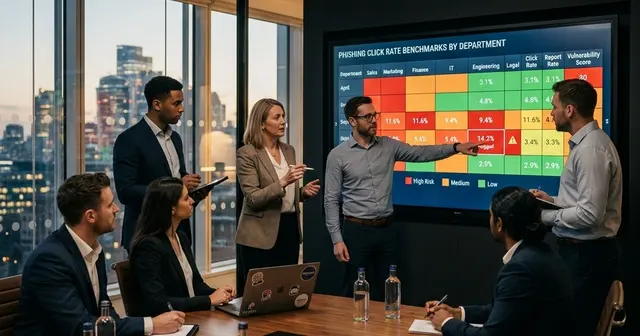
Phishing Risk by Department: Finance, HR, IT & Executive Click-Rate Data Compared
Sales clicks phishing at 28-35%. IT clicks at 6-12%. Phishing risk by department dwarfs industry-level variation, yet most security programs treat every team identically. Here's where the risk really concentrates.

How to Reduce Employee Phishing Click Rates: A Practical Guide for Security Teams
A high phishing click rate is not a character flaw in your workforce. It is a measurable problem with measurable solutions. Here is how to systematically bring it down.
Ready to stop phishing attacks?
Run realistic phishing simulations and high-impact security awareness training with PhishSkill's automated platform.